
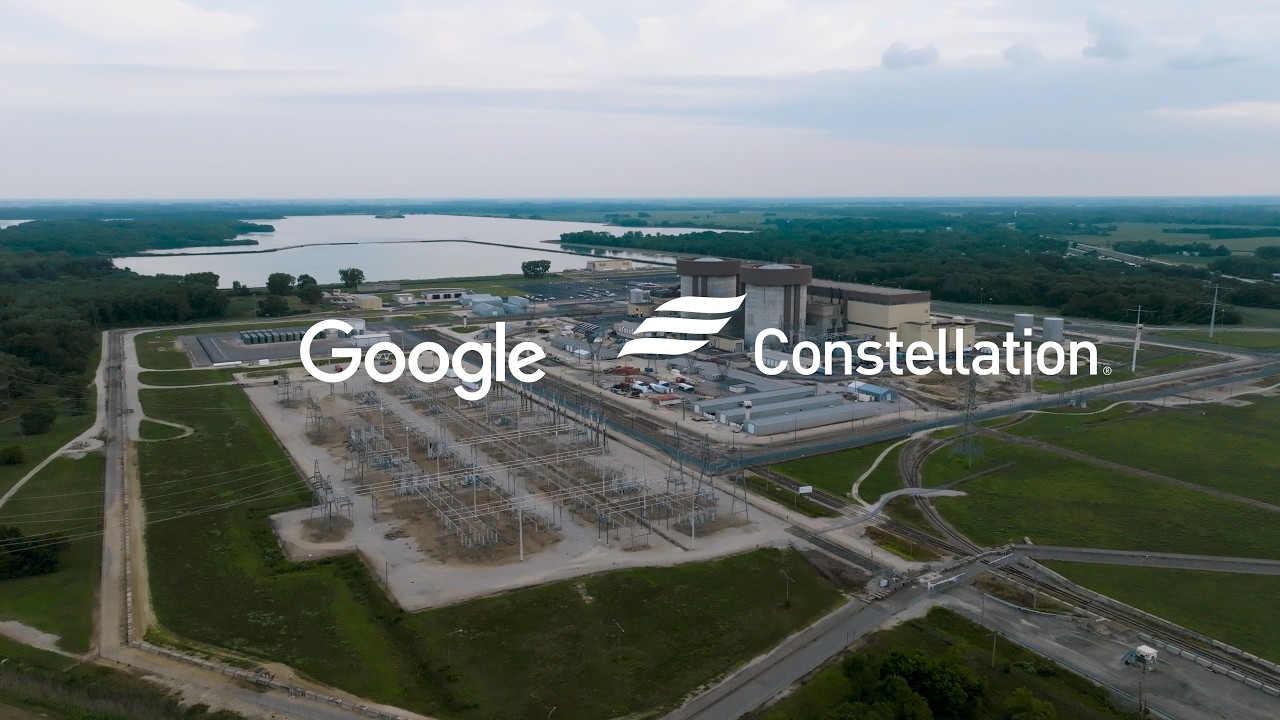
Google and Constellation's announcement gives the utility a customer-backed capacity plan, not just an AI demand story. Google will buy 890 megawatts of new nuclear capacity under a 20-year power purchase agreement covering 11 existing units in Illinois, Pennsylvania, and New Jersey. Constellation says the plan requires more than $4.3 billion of investment. That combination changes the company's forward economic profile by attaching a long-lived customer to capacity that still has to be built through uprates.
The market treated the change as material. Associated Press reported that Constellation rose 12.2% on October 6, compared with a 0.6% gain for the S&P 500 and a 0.4% gain for the Nasdaq. That is evidence of attention, not evidence that the project will earn an attractive return. The unresolved question is whether contracted demand becomes reliable nuclear cash flow or remains a long-dated construction obligation.
The agreement clarifies the conversion path. Constellation expects the first uprate by 2028 and the full 890 megawatts before the end of 2032. It also announced a separate 15-year agreement to supply 2,700 megawatts of energy from its PJM fleet. The first contract is a capacity expansion tied to Google's demand. The second is a longer supply commitment from existing assets. Both improve demand visibility, but neither discloses the PPA price or project-level return that would determine the cash return.
That gap matters because Constellation's latest operating baseline remains mixed. In its second-quarter results, adjusted operating earnings rose to $2.55 per share from $1.91. Yet nuclear production fell to 44,160 gigawatt-hours from 45,170 gigawatt-hours, and the nuclear capacity factor fell to 93.0% from 94.8%. The company said unfavorable nuclear outages partially offset earnings. A customer can anchor demand, but the value still depends on the megawatts being available when the contract calls for them.
The company's Form 10-Q reported $7.504 billion of second-quarter revenue and $580 million of operating income. Those figures establish company scale. The more than $4.3 billion commitment still lacks disclosed incremental earnings, project returns and PPA economics. Delivered capacity, fleet availability and the price paid for the power will determine how that demand converts into cash.
Broader hyperscaler activity supports the demand side of the case, while Constellation's return still depends on execution. Google says its agreements enable more than 1.5 gigawatts of U.S. nuclear capacity, and Axios reported that Microsoft, Meta, and Amazon have pursued similar nuclear-power arrangements. That broader activity makes hyperscaler demand look more durable than a one-off experiment. Constellation's price, project return and valuation still require evidence. Sector demand can be strong while a specific uprate earns too little after capital and operating costs.
The announcement has solved the demand question more than the return question. Constellation now has a named customer, a long contract and a visible investment schedule. The economics remain unresolved because they depend on what the power earns, how reliably the uprates arrive and whether the existing fleet's availability supports the promise. The first useful test is whether the initial uprate arrives by 2028 and the full 890 megawatts by the end of 2032. The next is whether Constellation reports delivered generation, availability and incremental economics that make the more than $4.3 billion commitment look like a cash-flow asset rather than an expensive obligation.