
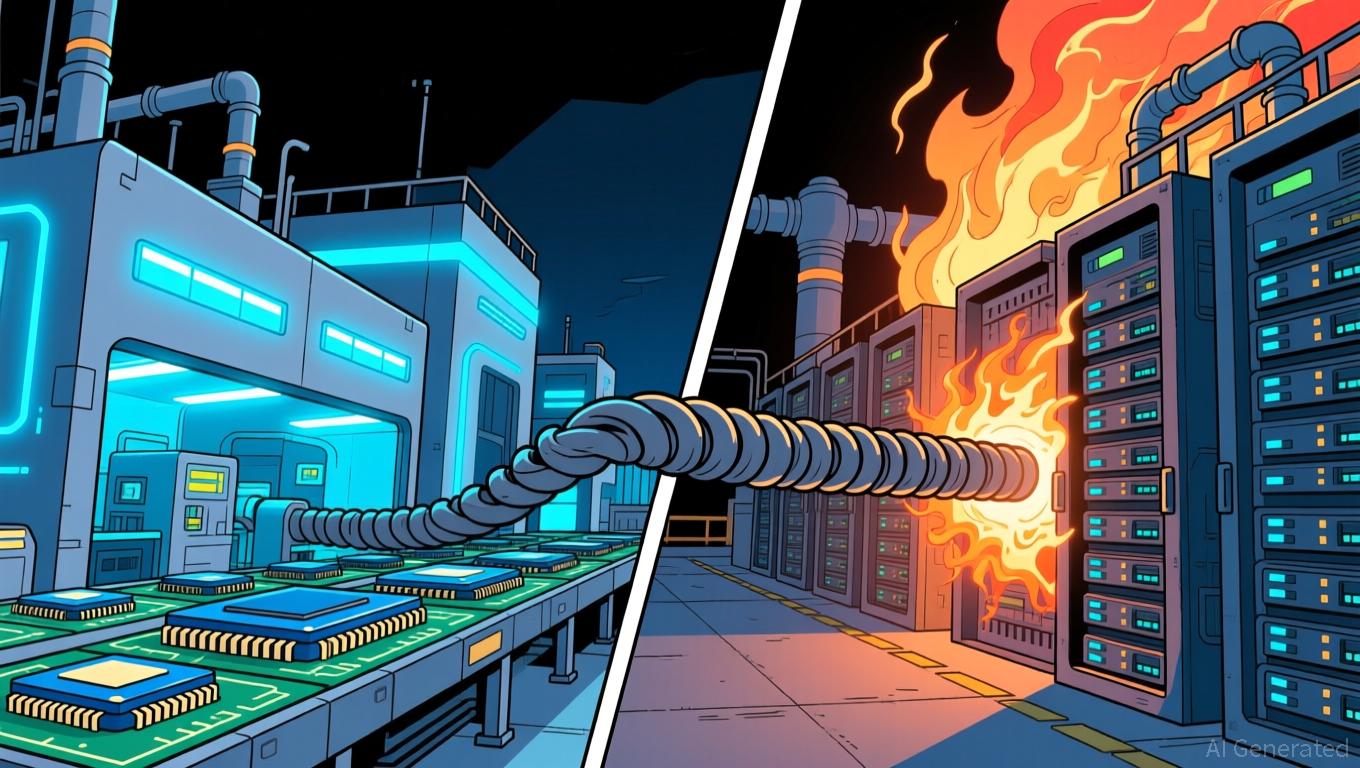
Taiwan is the country the AI boom runs through, yet the buildout of its own AI data centers is still small-scale. In the five years it collected AI data-center power applications, the state utility Taipower rejected 39 of the 79 it received and saw more than 70% of the capacity it approved lapse because applicants never moved to formal procedures. As of November 2025 only four sites were actually drawing power, at a combined contracted load of roughly 303.5 megawatts. For all the chips it ships, the island hosts only a modest slice of the compute those chips enable so far.
That gap is the point of the numbers that follow. Market commentary routinely collapses Taiwan into a single "AI winner" story, but the country holds two AI businesses with opposite economics: exporting advanced chips, and hosting data centers that run models. They are being throttled by different things.
The chip-export story is the one behind the marquee equity. Taiwan Semiconductor Manufacturing Company, whose valuation and revenue track the global buildout of AI servers rather than anything built on the island, is the clearest symbol of it. The data-center story is the one still held back by power delivery. Fitch Ratings, which affirmed Taiwan's sovereign rating at 'AA' this August and separately raised its Taiwan growth forecast on the strength of AI-related demand, sees energy cost as the risk cutting through that optimism. The growth forecast and the credit rating are about chip exports. The electricity constraint is about everything else.
So why would power, not chips, decide how much AI compute Taiwan actually hosts? It is not because Taiwan runs short of electricity as a whole. Twreporter, which obtained the Taipower data, reports that data centers used about 1.5 billion kilowatt-hours in 2025 - roughly 0.5% of the national total of 282.8 billion. The bottleneck is local. Power is tight north of Hsinchu, where metropolitan load density and slow substation projects leave little spare capacity; in 2024 Taipower suspended new data-center applications above 5 megawatts north of Taoyuan. Approved capacity is small against U.S. hyperscale scale - Google's roughly 250-megawatt Changhua facility is the largest on the island, where a handful of megawatts is a normal data center load.
Then comes the irony that ties the two stories together. The force crowding the grid is Taiwan's chip boom itself. Semiconductors consumed 42.38 billion kWh last year, about 15% of national power - roughly 28 times the data-center figure. And Taipower projects semiconductor expansion to add roughly 3.24 GW by 2030, ahead of the estimated 1.85 GW of new cumulative AI-related data-center demand. The very exports that make Taiwan the AI winner are the load that blocks it from becoming an AI destination.
For a U.S. investor, the consequence is to stop extrapolating the American data-center boom onto Taiwan. Much of the large-scale model training that would justify hyperscale buildouts remains in the United States, and the operators who filed for Taiwanese capacity often treated it as optional interest rather than commitment - hence the lapsed approvals. The trades are different: a chipmaker benefits from AI wherever it is hosted, so TSMC's ~$2.45 trillion market value and forward P/E near 47 (Ainvest data) rest on global AI capex, not on Taiwanese data centers.
The observable that would change that reading is the connection queue. Today the energized and under-construction base sits at roughly 870 megawatts. If approved-then-lapsed applications get re-filed as real construction, and if developers push south toward looser grids despite the latency cost of moving away from northern customers, Taiwan's domestic compute story starts to matter. Until then, its AI promise is a power-delivery problem wearing a chip story's clothes.